
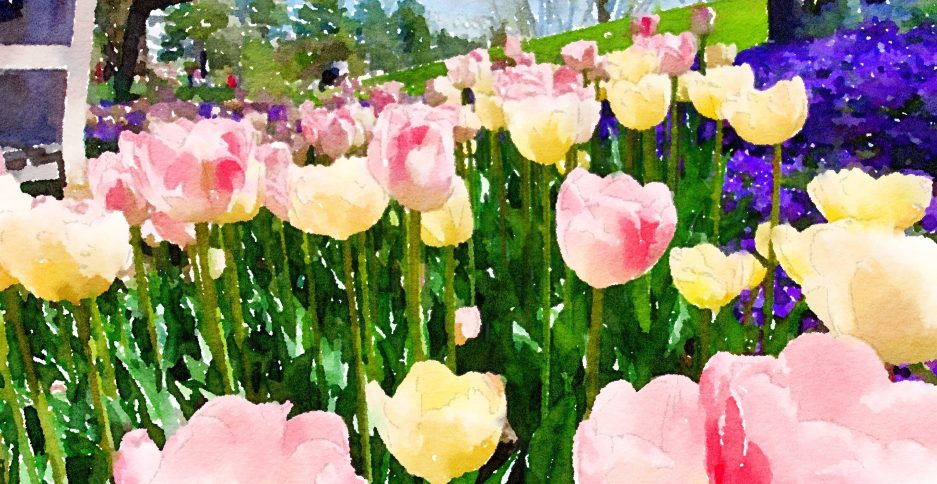


So it’s been kinda cool this week, temperature wise. And get this…we’ve had rain showers on several days. With temps hovering around 46ºF (7ºC) when we take our morning walks, a chap has to warm up before he goes out. Oh don’t get me wrong, I’m not complaining about the cool temps. Both Mum and I are enjoying them and the gentle rain has really brought out the curls in the Floof. To top it off, the rain has made gardens look pretty amazing.
We all know that May is a great season for blooming peonies and irises but today we’re going to showcase another favorite flower…the common rose, which also loves to bloom in May.
Wilson: What’s that old Shakespeare’ saying? “A rose by any other name would smell as sweet.” Guess ole William didn’t figure on genetics affected that once familiar scent. You may have noticed that roses don’t smell like they used to years ago. So why don’t roses have that luscious fragrance anymore, Mum?
The Mum: It all boils down to 3 words-economics and disease resistance, House Pony. Many years ago, as the floral industry realized they could import roses from other countries cheaper than growing them in the US, they teamed up with genetic science. Growing overseas would require sufficient time to ship cut flowers back to US consumers who demanded longer lasting roses and roses with large blooms were especially sought after. Enter Ecuador whose roses boast the largest blooms in the world and are thus some of the most sought after because of their size. Crossing breeding efforts to achieve those larger blooms, longer thornless stems, increased petal count, and disease resistance unfortunately replaced the gene which removed that beautiful fragrance. We may enjoy bouquets longer, but the price is those bouquets no longer have the fragrance that we all know and love, unless the rose happens to be one of the David Austin varieties. Apparently the two genes are incompatible. But all is not lost. Science is working on a solution by breeding compact fragrant roses that are healthy and have a lovely perfume as well. The bad news is that in order to create fragrant cut roses that are durable may take as long as 10 years to develop a fragrant, disease resistant rose but work on that continues. Once that happens, that Shakespeare quote won’t need to be changed. In the meantime, let’s take a look around our neighborhood to see some of the beauties that have been blooming.


Wilson: Just goes to show life isn’t perfect but there’s always going to be someone who’s willing to try to build a better mousetrap, Mum.

The Mum: That’s quite true. I felt lucky to capture most of these roses after a little shower so there are still droplets on the blooms and leaves that I think add to their beauty.


Wilson: I think my favorite color are the pinks. They manage to look the best longer than some of the other colors whose petals get a bit ragged looking around the edges. Still all these beauties looked so lovely when we saw them on our walks and the good news is that most of them (with proper deadheading), will continue to bloom throughout summer.


The Mum: Right you are, Floof. The ‘show’ will go on, presuming summer heat doesn’t impact them too much. I’m willing to keep my eyes on them. How about you?
Wilson: Oh yes, it’s always good to look forward to beauty when and wherever nature provides it, be it on rose blooms or other flowers. So, do you have any plans to welcome the month of June? I think we’re probably just going to catch up on garden chores after all the rain that fell has fertilized weeds like crazy. After over a week of cool temps, the weather will start warming up and weeds are popping up everywhere, just waiting for Mum’s hoe. I’ll be sure to snoopervise her from the shade of the covered patio. One must practice their keen ‘quality control’ skills to make sure the human doesn’t slack off, don’t you think? We hope you have a splendid weekend and are able to get outdoors to enjoy a spot of sunshine or find some beautiful flowers in bloom along a walk. Enjoy…whatever you choose to do.


Live, love, bark! 🐾


