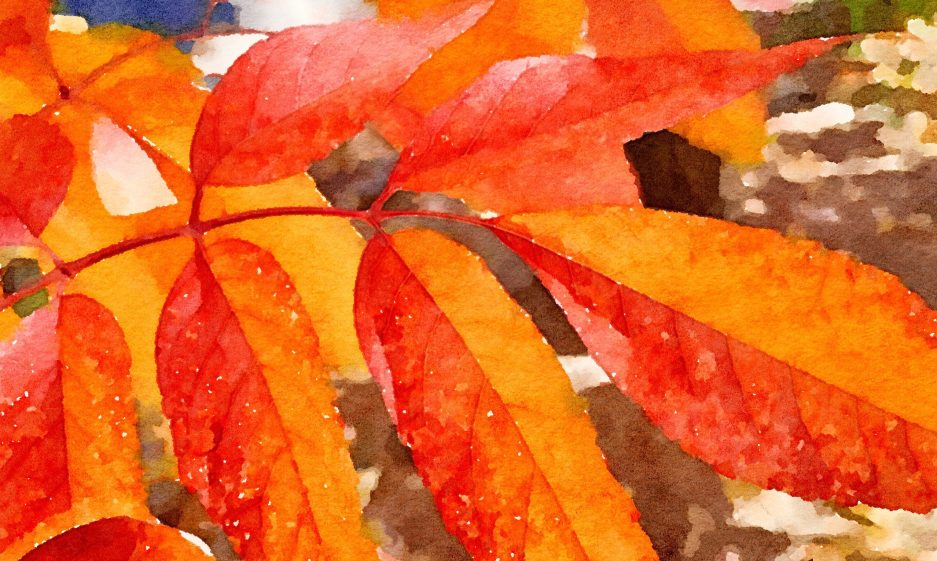
Welcome to Nature Friday where we join those lovable pups from Adventures of the LLB Gang. Don’t forget to click on the link to see what others have shared. Wilson here. We have a few odds and ends of nature from around our barn. Mum’s had a busy week, but I convinced her to take a few photos in between. Nature is still doing the slow roll to changes leaves but we managed to see some sumac trees surrounding one of the anti-flood retention ponds that were beginning to turn to bright orange.


While striking in color, Mum is not a fan of this shrub. It tends to be invasive but in a landscape with not a lot of autumnal color yet, it’s fairly attractive.
Wilson: It was actually an accident that Mum found those trees. She’s still learning the neighborhood and was on an errand and encountered one of the scariest Halloween decorations she’s ever seen. She had not walked along this street before and this caught her by surprised. She scurried around the first corner to get away from it as fast as she could and found those trees which helped her get over the heebie jeebies that thing gave her.

The Mum: Creepy, right? Now you know why I couldn’t get away quick enough from it. That shock of orange sufficiently distracted me while I caught my breath.
Wilson: Catch your breath or begin to breathe again?
The Mum: Umm, most likely the later. Clowns are scary on general principles but this one…nope, nada, not going there again any time soon.
Wilson: I don’t blame you, Mum. Halloween decorations are beginning to pop up, and truth be told, are appearing a bit more than the changing leaves. With all the cottonwood trees along the creek trail we walk every day, I know you were expecting a whole lot more of those bright, golden heart-shaped leaves but with the ongoing drought, I think their appearance has been delayed.
The Mum: Mostly likely. I’m not sure there’ll be a great show this year because of the drought. Many of the leaves are starting to fall and they’re frequently brown and the trees only have small little patches of yellow. There doesn’t seem to be as many maples and ash trees in the neighborhood like our old one. It’s been an adjustment for sure, much like the Halloween decor. I miss the gigantic skeletons that were posed in different scenes. I may have to swing by the old neighborhood just to see them. Luckily most of the decorations in our neighborhood (other than that terrifying clown) are far more benign. I saw our friend, Giddy Goose just down the street dressed up as a cute ghost…something more in line with my sensitivities. Pretty cute, huh?

Wilson: I dunno, Mum…color me dubious. That goose seems a bit sketchy to me.
The Mum: Don’t be ridiculous. Giddy Goose is friendly and just because a slight breeze kicked up its sheet, it would never hurt you.
Wilson: I’m still skeptical and plant to stay way clear of it. I’d rather focus on some of the pumpkins that are showing up although I’m not sure I’m very inclined to taste test that middle one…it seems to have a few barnacles on its skin. The Mum: You’re too funny…always thinking of your stomach. That’s an ornamental pumpkin, not one you’d want to eat. Rabbits might, but you definitely shouldn’t.
Wilson: For the record Mum, there’s absolutely nothing wrong with wanting to make sure that anything that crosses my lips is healthy and tasty. I have discriminating tastes and won’t just eat anything.
The Mum: Ha…that’ll be the day! You have the appetite of a starving refugee which is why I have to watch you like a hawk so you don’t ingest something that isn’t good for you.
Wilson: {gasp} You cut me to the quick, Mum. Being a growing boy, I’ll admit I’m a bit hungry most of the time.
The Mum: A bit? Hahahahaha. I think your legs are hollow. And you’re not a growing boy. You’re fully formed. You slay me sometimes. What else have you got.
Wilson: I’m slighted by that observation, Mum but I’m not going to stoop so low as to respond. Instead I’m going to share this sunrise from the other morning. Early mornings the sun is late appearing and it delays our walks. It’s probably just as well-we can let the wildlife sleep in a few extra minutes before we hit the trail although I’m sure we’ll be adjusting our schedule to go later after the temps aren’t quite as crisp and we’ll wait until the sun comes up a bit to warm things up. Although I must say I’m enjoying these crisp mornings. It leaves me quite frisky.

The Mum: It was a pretty sunrise and it did make for a lovely early morning walk. The weather has been quite pleasant although it’s been unseasonably warm. Warm enough to see multiple heat records this week but I heard a rumor that maybe by next weekend, we may have our first frost with a bit of white stuff. We’ll see though…the forecasts for the Super El Niño have not panned out the way they’ve been telling us they would.
Wilson: Yeah, I’ll believe it when it happens. In the meantime, I’ll enjoy what Nature is dishing out. That’s it from us. We hope you have a terrific weekend enjoying autumn and preparing for Halloween. Have any special plans? Whatever you do, we hope you are able to enjoy a fabulous weekend.

Live, love, bark! 🐾

 Happy Friday. Today is a special day, I’m penning a two-for-one post! First, as we typically do, we are joining the


 Welcome to this week’s edition of Nature Friday where we join the
 The Mum: I love seeing them in person. I’d heard them earlier yipping just before dawn but hadn’t seen them along the trail for a while so this chance encounter was quite serendipitous.


 Welcome to the last Friday of September and the first Friday of autumn. Hallelujah…our favorite season is here. Woof, woof. Today is notable in that there are a couple of other celebrations. Blogville’s very own Mum to Teddy and Angel Sammy from

