
And so the ongoing battle between the 80 lb. quilt continues. I swear this dog rather enjoys ‘busting a move.’ On top of me.
Here’s hoping all your moves this week are pawsome. Happy Monday.
Live, love, bark! 🐾
Adventures about pet therapy, dog rescue and urban life in the 'Burbs
And so the ongoing battle between the 80 lb. quilt continues. I swear this dog rather enjoys ‘busting a move.’ On top of me.
Here’s hoping all your moves this week are pawsome. Happy Monday.
Live, love, bark! 🐾
 Wilson has found a new treat that he likes. Although he would rather it would have been an apple slice from the charcuterie board leftovers, he was more than game to try a slice of cucumber. What treats do your dogs like?

Whatever snack you prefer, we hope it adds to a ‘pawf-fect’ Monday for you.
Live, love, bark! 🐾
We hope your holiday weekend was ‘pawsome.’ Anyone who owns a pet knows the drill when it comes to taking care of the water bowl. All I can say, is it’s a good thing the ‘other’ bowls all have lids.

We hope your water bowl (as well as the week) remain clean and fresh. Happy Monday!
Live, love, bark! 🐾
We’ve been busy driving back and forth to my Dad’s to get him settled in his new senior independent living facility and preparing his house for sale and won’t be posting the rest of this week. It’s been very hectic for me, but we continue to be very committed to supporting a cause that’s near and dear to my heart-canine epilepsy awareness. Which leads us to happily post our support for this year’s Purple Day for Epilepsy as hosted by the FiveSibes.

Even though my beloved Ninja Angel Elsa, earned her wings last year, we are once again participating in the annual Purple Day for Epilepsy Blog hop. Elsa was diagnosed with idiopathic epilepsy shortly after I adopted her. It was through their blog hops promoted by Dorothy Wills Raftery, the award winning author and epilepsy ambassador, along with co-hosts “Ruby the Therapy Dog, Knotty Toys For Good Dogs and Gibbs-erish Making Sense of Canine Epilepsy” (all can be found on Facebook), all of whom contributed valuable information that helped me provide Elsa with a good life. We will always be grateful for all the info that has been (and continues to be) shared over the years on their respective blogs and on their Facebook pages about canine epilepsy. I continue to remain ever so grateful for their help and all the information and resources that they shared about epilepsy over the years. Please visit the Purple Day website for additional information about epilepsy.
 Elsa was living proof that dogs who were diagnosed with this condition were still able to live relatively normal and happy lives so it’s only natural that Wilson wanted to participate in memory of his little sister by wearing her purple bandana.

Please check out the Purple Day blog hop post at the FiveSibes link. The more awareness is raised, the better we can support those who suffer from this condition.

Live, love, bark! 🐾
 Happy Monday. Today is Wilson’s favorite day. Not because it’s Monday but because it’s International Dog Biscuit Appreciation Day (also known as National Dog Biscuit Day). Woof, woof! What’s the story behind this special day? We did some digging and hope you enjoy the back story. Plus, in honor of the House Pony’s favorite day, we’re sharing a few recipes from our dog treat cookbook that you can make for your own dog’s favorite day.
So here’s what I discovered about how dog treats came to be a billion dollar business. I learned that the term “dog’s bread” had been around since Roman times. It was frequently labeled “bad bran bread,” with the term being associated with treating people poorly.
Back in early 1800’s England, dog biscuits began to show up that resembled what we are more familiar with now. Made with vegetables, grains, and bran, the mixture was baked together and sold as a treat, with claims made that they would improve a dog’s coat and skin.
The first mass-produced dog biscuit was created by American, James Spratt in London when he began manufacturing his “Meat Fibrine Dog Cake” around 1860. Ingredients were wheat meal, vegetables, beetroot, and meat.
These “dog cakes” were originally marketed to the English gentry for their sporting dogs. Spratt’s Meat Fibrine Dog Cakes began to show up in the U.S. in 1881, and were considered a luxury item and were marketed at dog shows. They appeared on the cover of the first journal of the American Kennel Club in 1889. Spratt’s Patent, Ltd. also supplied army dogs with hundreds of millions of the biscuits during WWI.
Not to be outdone, American F. H. Bennett began to compete against Spratt by making the first bone-shaped dog biscuit, known as “Milk Bone.”
A fascinating side fact that I learned was that a box of Milk-Bone treats made an appearance in the 1924 silent film The Tomboy, and later was the basis for a line from the TV sitcom Cheers, spoken by the character Norm, who was played by George Wendt. “It’s a dog-eat-dog world and I’m wearing Milk-Bone underwear.”
So in honor of the Floof’s favorite day, here are two recipes from our treat making cookbook that you can make for your dog’s favorite day. Enjoy!
Prep time: 25 min. Cook time: 40 min.
*We blogged this recipe way back when in October 2016. Original post can be seen here.
Mix all ingredients until well combined. Press into a ball, wrap in plastic and refrigerate for a few hours or overnight. Lightly flour surface and roll dough out to about 1/2″ thick. Use cookie cutters or a small glass to cut out the treats. Bake at 250º for 25-30 minutes and allow to cool before serving. This recipe received the 4-paw seal of approval. 🐾🐾 Nom, nom!
And even though it’s National Dog Biscuit Day, it’s still a Monday, which means we start the week out with a smile or two. The first is in honor of the historic win by Team USA in yesterday’s gold medal men’s hockey, overtime win on the exact day 46 years ago when the upstart US team beat the Soviet Union back in 1980.

Because we know the East Coast from Maryland to Maine is being hit with more severe winter weather, we hope they will appreciate today’s smile. Stay safe, warm and be comforted with the fact that Spring officially arrives in 25 days. Hang in there.

Live, love, bark! 🐾
We hope you had a wonderful weekend but now it’s time to prepare for the week. With less than two weeks until Thanksgiving arrives in the US, preparations are beginning to become more apparent all over the neighborhood. Some folks have decided to blend the last holiday with the upcoming one. Despite the addition of yet another inflatable, I thought it was kind of clever despite the addition of yet another inflatable to their growing collection. Wilson simply wants to know what will be served. How are you getting ready for Thanksgiving?

Happy Monday!
Live, love, bark! 🐾
Happy Monday. Despite the recent executive order to the contrary, today is Indigenous People’s Day in the U. S. (aka Columbus Day). In his order, the president praised the 15th-century explorer as “the original American hero” and “a giant of Western civilization” which seems ironic in this day and age, given that Columbus was the first immigrant to reach the Americas.
But because it’s Monday, we need to start the week out with a smile. Today that means we’re joining the live coverage with ‘Louie’ as he covers a very important news story.

One thing I’ve learned about Wilson, is that he apparently can count and has seemingly mastered fractions as well. All of which means that dividing treats is forbidden around the Ranch. I no longer even try to pull any treat division like that here and have assured the House Pony there will be no ‘crime scenes’ around the Ranch about that.
We hope the news in your neck of the woods involves only whole portions. Make it a pawsome Monday and an even better week.
Live, love, bark! 🐾
Greetings, mates. Tis I, Wilson, the fabulous floof here to welcome you to the first Friday of October. For those keeping track, today is the 276th day of the year with just 89 days left until we can tuck 2025 in the history books. This week we captured some images showing October at its finest as well as learned about some of the dangers that often live in our gardens. Let’s get started but first, as always we’re joining our friends from Adventures of LLB and hope you will check out their link to see what others have posted this week.
Wilson: So my Mum and another rescue volunteer drove up to Evergreen, Colorado, a lovely mountain community located about 20 miles west of Denver to check out a potential adopter. They couldn’t help but wonder how bad the traffic might be going up on a weekend with all the city leaf peepers heading up to the high country and were pleasantly surprised that the ride up was nothing like the cluster it was last year. It was a cool day but you couldn’t ask for lovelier weather. Evergreen’s elevation is 7,220 ft. (2200 m) and the aspen leaves were beginning to change into their trademark gold colors. Against dark evergreen trees, you could see those ‘quaking aspens’ from miles away.

The Mum: It was a gorgeous day and it was a thrill to see Populus tremuloides often referred to as Quaking Aspen leaves are beginning to turn in areas all over the state. According to the U.S. Forest Service, the Quaking Aspen is one of the most widely distributed trees in all of North America. They are a tall, fast-growing tree, usually about 15–18 m. (50–60 ft) tall at maturity, with a relatively smooth white bark that is marked by thick black horizontal scars and prominent black knots. When you see parallel vertical scars you know the elk have been munching on the bark with their front teeth particularly during winter months when grass is buried in snow. Quaking aspen get their common name from their distinctive leaves’ tendency to “quake” or tremble in wind due to their flattened stems. Aspen trees are considered the largest living organism in the world because of how they spread through a long underground root system, creating clones (suckers) with new trunks emerging from it, thus creating large clonal groves. Their leaves tend to be moist and do not readily burn and it has recently been reported that wildfires will sometimes bypass stands of aspen enclosed within a coniferous forest.
Wilson: After your rescue work, you guys drove back home from Evergreen and enjoyed the show of gorgeous changing leaves and wide open meadows where elk walk through grazing on grass.


The Mum: It was a quite a sight winding down the mountain and seeing those spots of gold dotting the landscape. Every turn provided another gorgeous view.
Wilson: Pretty cool, Mum. This week had a few slices signaling autumn’s arrival around our neighborhood too. Look at this clump of acorns Mum found. I can’t believe the squirrels hadn’t eaten them.

The Mum : Aren’t they simply adorable?
Wilson: The squirrels?
The Mum: No, silly Floof, the acorns. You know my thoughts on squirrels.
Wilson: Whew…I was beginning to think you’d gone to the dark side, Mum.
The Mum: Not likely. So what else would you like to share?
Wilson: We found some very interesting but potentially dangerous plants along our walks. Check out this one! What is it, Mum?

The Mum: That is the castor bean plant and is widely cultivated in parks and public spaces. It’s surprising as it is quite toxic and extremely poisonous. I have seen it around and while those flowers are colorful and fascinating, I was shocked when I found out what it was. We won’t be planting it in our garden any time soon. Yikes!
Wilson: You seem to be on a roll, Mum. I see you’ve managed to find another poisonous plant. Caladium, also known as elephant ear or the heart of Jesus, is also poisonous. Native to South and Central America, they are hardy only to Zone 10 in the US and cultivated as houseplants or treated like annuals in a garden and should be lifted before the first frost and stored when temps reach 65F (13C) after the tubers have been dried. All parts of this plants are poisonous and should not be ingested and the leaves could irritate the skin.

Wilson: Ok, you’re beginning to scare me, Mum. Those plants were discovered along our daily walking routes. Should I be scared?
The Mum: Not really sweet boy, it was just a fluke that I found some beautiful plants that happen to be toxic. Nature provides defensive strategies for lots of critters and plants to allow them to survive in a world that can be threatening to them. Even like this beautiful hydrangea which I learned is toxic to dogs, cats and horses. This is why I keep you on a short leash to avoid encountering anything dangerous.

Wilson: I’m getting nervous walking around because you know I love our walks and love to sniff.
The Mum: Don’t worry, buddy. It’s good for dogs to sniff, because it activates your brain, reduces anxiety and provides mental stimulation. Besides, I watch you like a hawk to make sure you stay safe and don’t get into plants that could cause problems.
Wilson: I appreciate that, Mum even if I sometimes wish I could roam freely without such close observation, it sounds like being careful is the best strategy and appreciate that you look up all the plants that we encounter on our daily jaunts so we can avoid any toxic ones.
The Mum: It’s good to learn about the natural world in general but especially prudent to avoid encounters that could have unpleasant consequences. Learning about common plants we may find in our garden provides us with the necessary information to stay safe. So what’s on your weekend agenda? Have you got any plans?
Wilson: Nothing really specific but I hope we can go check out Sloan’s Lake and watch the lake birds. The weather should be lovely and I’m sure there will be lots of people enjoying the pleasant temps and changing leaves. We hope you have a terrific weekend full of beauty. Enjoy getting a healthy dose of Vitamin D!

Live, love, bark! 🐾
 In the immortal words of fellow Brit, John Oliver, Welcome! Welcome! Welcome! Tis I, the House Pony joining the pups from Adventures of the LLB Gang’s blog hop and boy do they have a good one today which I definitely could identify with. Be sure to click on the link to see what I’m talking about.
Well let’s see, ah yes, it’s the last Friday of September and we’re already longing nostalgically about this handsome month, knowing that in just 4 days, we’ll be entering the last quarter of 2025. On the one hand, it’s hard to believe there are just 96 days left this year (and only 90 days until Christmas in case you need some perspective, but more importantly, only 11 days until hockey begins). Well let’s start with the big news of the weerk.
This week we were blessed with an entire 24 hours of beautiful rain. Although not a fan of getting wet, Mum kept waxing on about how fabulous it was and so good for the garden. I reminded her the only thing fabulous around here is me, but she was over the moon and even my cuteness couldn’t deter her glee. She couldn’t take a photo since she doesn’t have enough thumbs to hold the leash and an umbrella to keep me dry. Even picking up after me practically required an act of God so she grumbled not being able to document me in the wetness. Just as well, you all know me as a cheerful, happy Floof. Trust me, I was less than cheerful or happy. Frankly I couldn’t finish the walk fast enough. But I did have to chuckle that she got a lot wetter than me because the umbrella (and my raincoat) kept me fairly dry except for my paddle feet and she was diligent about keeping the umbrella over me more than her. Serves her right.
The Mum. Well that wasn’t very kind, talk about ‘no good deed goes unpunished’ when it comes to trying to keep you dry.
Wilson: I don’t mean to sound ungrateful but you know how I feel about wet. I don’t like. it. one. whit.
The Mum: Well, I think you shouldn’t look a gift horse in the mouth. Or umbrella. But let’s put that behind us and share what we encountered this week, naturewise.
Wilson: {eye blinking in abject dis-interest} Well then, if you can’t commiserate about me having to walk in the rain, let’s get to it.

The Mum: Aren’t those pink seed capsules absolutely adorable? Euonymus europaeus, known as spindle, European spindle, or common spindle, is native to much of Europe, where it is found on the edges of forests, hedges or gentle slopes, none of which exist in my garden so I have no idea from where it came. When I looked it up, I learned that birds are attracted to the fruit and most likely spread the seeds so much so that now it’s considered weedy and invasive in some areas. Like in our garden.
Wilson: Looks like teeny, tiny pink pumpkins to me.
The Mum: Precisely.
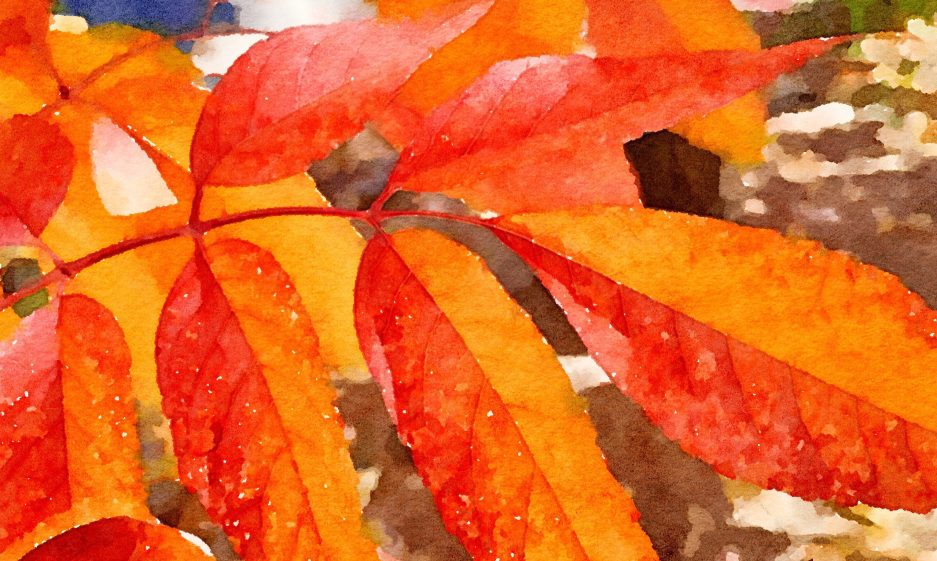
Wilson: Judging from the photos you took this week, I can tell you’re really into the reds as September winds down and starts to yield to October ‘s version of autumn where maple trees will showcase their red and orange hues once the leaves really start changing. But then I noticed this little fella just lying in the grass. We didn’t see any maple trees nearby from where it might have come but I guess it just means they’re being coy and shy. Right now 99% of any trees changing colors are leaning toward bright gold.

The Mum: The reds and oranges aren’t as prevalent in our area so when they show up, they are pretty spectacular like that maple leaf as well as this Horse Chestnut tree we came across yesterday morning.

Wilson: As a dog I’m not supposed to be able to see colors as well as you uprights, but I can tell these are pretty colorful. What do you know about the Horse Chestnut tree, Mum?
The Mum: What I learned is it’s a medium growing, shade tree, that’s not really a chestnut tree. Its fruit is inedible and the nuts are somewhat toxic. The name comes from a mistaken, belief that it cured chest ailments in horses. Fact is, Horse Chestnuts are actually toxic to horses, but of course the urban garbage disposals, otherwise known as squirrels seem to be able to break down the toxins and safely eat the nuts. You can guess I won’t ever be planting any of those trees in my yard.
Wilson: Gee Mum, you’re no fun. It’d be a great way to attract my favorite nemesis. We’d both get loads of exercise, me chasing; they trying to avoid my jaws of death. Why in the world would you deny me that pleasure.
The Mum: Squirrels have already chewed through my kitchen window three times, I’m not a halfway house for neighborhood hoodlums.
Wilson: Gee Mum, you’re no fun. So tell me more about this sage.

The Mum: Sure, House Pony. That’s Salvia microphylla, commonly called baby sage. Native to Mexico and parts of the Southwest, it’s a hardy, sun loving, drought resistant perennial shrub. It’s a somewhat bushy evergreen shrub that is able to adapt to diverse conditions.
Wilson: Interesting. Well I rather liked this Malus, which includes both culinary apples as well as these crabapples in the genus. It’s especially pretty against a crystal blue sky after that rainy day earlier in the week. This one was lovely with beautiful blossoms back in the spring and now is showy producing all these tiny little apples in autumn. Crabapple trees are mostly considered ornamental trees but I’ve heard crabapple jelly is mighty tasty. But I can’t imagine what a job it’d be picking and coring the little fruit.

The Mum: Good point, not a job I’d take on. But like you said, they are a lovely ornamental tree that we can agree on, enjoying them in spring and autumn. Speaking of autumn, looks like the neighborhood is gearing up for Halloween with a bunch of skellies showing up. The house that I’ve featured many times for it’s overkill of inflatibles has started with a bunch of new decorations. Hopefully this means there won’t be all those hideous blow-ups cluttering the entire yard. I know they’ll eventually fill the entire lot since I saw a pickup with a trailer being unloaded with tons of boxes. They clearly have a storage unit where they store all this junk stuff. Sigh. But at least it’s not as tacky as usual. Yet, though it’s early days.

Wilson: I wasn’t sure if I needed to defend you or run away from that thing. I do believe those folks must be slightly odd but the lady there always enjoys seeing me.
The Mum: She does, but I think her husband is a lot like this ogre, he never replies when I say hello. Course if hauling all those things back and forth (note the gigantic boxes in the background on the porch), I guess I’d be unfriendly too.
Wilson: It’s never good not being friendly, Mum. And besides, who can easily refuse moi, a fabulous Floof? Huh? I rest my case.
The Mum: I can’t say but think it’s rather rude not reply to a friendly hello. Oh well. It’s a sign of the times. Well, that’s about it for us. I just heard it’s National Pancake Day so maybe I ought to fix us some pancakes, what do you say?
Wilson: Pancakes, Yes please! But before we go, please have yourself a gorgeous autumn weekend and be sure to get out and enjoy some of the beauty Nature is dishing out for our enjoyment. Cheers!
Live, love, bark! 🐾
 Today we are doing something different from our usual fare, we’re reviewing a book written by the award winning author, Dorothy Wills-Raftery. Dorothy is one of the premier lay people on canine epilepsy and one with whom I became acquainted with nearly 10 years ago following the rescue of Elsa, my Standard Poodle shortly after her epilepsy diagnosis came following her adoption. Elsa has now been a “Ninja Angel” for 5 months (gosh…where has the time gone?) and not a day goes by that I don’t think about her and still miss her every single day. Dorothy’s blog and all the resources she shared got me through some dark times trying to help keep Elsa well and live a good life despite the diagnosis. She made me realize that epi-dogs can live great lives despite the diagnosis. I shall forever be grateful for her support, knowledge and shared resources.


Live, love, bark! 🐾 💜 🐾