
Welcome to Friday where we join our friends, Rosy and her brothers from LLB in the Our Backyard. Today let’s stroll around the Denver Botanical Gardens where ‘gardening with altitude’ is how we roll in the Mile High City.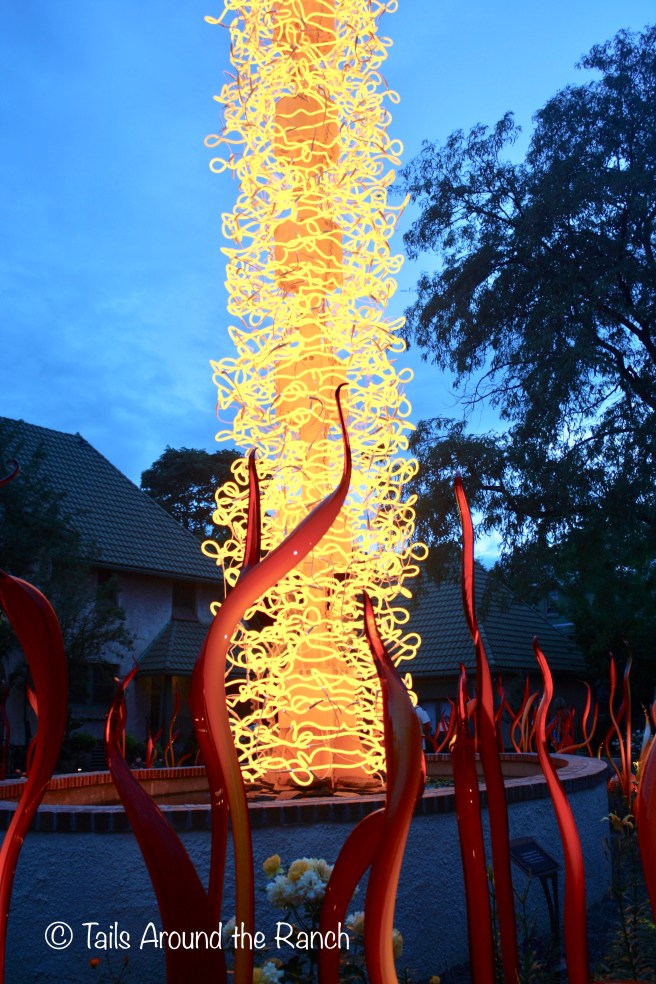
Officially created in 1951, the Denver Botanic Gardens has come a long way from its humble roots. Beginning as a small rose garden in Denver City Park near the Museum of Natural History, it became clear the garden was a bit too public as the roses were constantly being dug up by visitors. Thus a number of influential city leaders began looking for a more secure space. They found a large flat spot a couple of miles to the south in the Cheesman Park neighborhood. Originally Denver’s first cemetery, the graves were relocated (although an occasional grave still turns up every once in a while) and the garden oasis began to evolve into what it is now. Featuring the largest collection of plants from cold temperate climates around the world, it includes seven diverse gardens that primarily include plants from Colorado and neighboring states.
Located just behind the Ruth Porter Waring House (originally used as the administration building and gift shop), the Romance Garden has a spectacular Chihuly sculpture (from the 2014 exhibit). It’s beautiful during the day but near dusk, it is even more spectacular.

At the opposite end of the gardens is the Shofu-en, or the Garden of Pine and Wind, a traditional Japanese strolling garden, another visitor favorite. Drawing its inspiration from the area’s climate and plants from Colorado’s Rocky Mountain region, there are 130 character pines transplanted from the foothills. The garden was designed by Koichi Kawana and is celebrating its 40th anniversary this year.

No visit is complete without a stroll around the Monet Pool. The spectacular collection of water lilies in bloom this time of year are always well visited.

Last on this tour is the Boettcher Memorial Tropical Conservatory. This structure is unlike any in the world, built from concrete (Charles Boettcher made much of his fortune in concrete), it contains faceted and curved plexiglass panels specifically designed to have the condensation flow down the structure into the watering system. When built, it was the only tropical conservatory between Missouri and San Francisco. Some 2000 species are cultivated in the conservatory.

Hope you enjoyed this week’s tour of nature in the city. The DBG is my favorite 24 acres in town and a wonderful place to spend a few hours enjoying elements of nature in a hectic world which proves you can find amazing views of nature even in an urban setting.
We wish you a terrific Labor Day ‘howliday’ weekend and hope you are able to get out and enjoy some of the many fine offerings nature provides on this last weekend of summer.

Live, love, bark! 🐾


 Hi-ho, hi-ho, it’s off to West Pines we go.🎶 After many patient and staff visits (and more than a few ‘dates with nurses’) at hospital yesterday, Sam is off to West Pines this morning. We had loads of interaction with all sorts of folks yesterday from two year olds to eighty plus year olds including a surprising number of visits at hospice. Since it was the first time this summer that Sam has been back, I wasn’t sure how he’d do. But my boy proved he’s still got game and was only slightly off kilter. I tried to make yesterday’s shift as easy as possible and he seemed to enjoy the lighter duty. His hospital friends we always visit were very happy to see his sweet face. When I saw the smiles he put on people’s faces, I know he was back in his element despite being tuckered out once we returned home. Visits normally take a lot of energy out of him, but after a good night’s sleep, he’s raring to go today and ran toward the garage before our morning constitution.
 Happy mid-week. May the slide toward the weekend be an easy one for you.




 This week is all about waterlilies. A recent trip to the Denver Botanical Gardens proved this is prime time for viewing these plants. Frenchman Joseph Bory Latour-Marliac (1830-1911) often considered the father of hardy waterlily hybridizing, creating over 100 hybrids in a rainbow of colors using species from around the world, including North America, as parent plants. Until the introduction of these hybrids, most people in Europe were only familiar with their native white-flowering hardy waterlily, Nymphaea alba.
 In 1889, Latour-Marliac displayed many of his new waterlilies at the World Fair in Paris, where they won first prize and caught the attention of one Claude Monet. Monet placed an order with Latour-Marliac’s nursery (which still operates to this day in Le Temple-sur-Lot, France) and soon thereafter, planted them in his new garden in Giverny. The rest is history.
 The Botanic Gardens’ collection includes twenty of Latour-Marliac’s historically significant hybrids in its own “Monet Pool” that were originally introduced in the gardens in the early 1900’s.


