While we haven’t had an over-abundance of snow yet, other locales across the country have been inundated. What does this mean when you have a dog? Well in our case, it means when we go outside for daily walks, we run of the risk of harming fragile paws from neighbors who over-enthusiastically spread snow melt on sidewalks and driveways. Great for humans, not so great for the ‘paw set.’
Sure, putting on boots for extended walks protects them but installation on 8 paws isn’t possible all the time or particularly appreciated by the fur-gallery around the Ranch. Sam reluctantly allows boots, but Elsa on the other hand starts pirouetting around like Mikhail Baryshnikov. I haven’t been able to convince her yet that snow boots are not some torturous form of Chinese foot binding. So we often end up walking in the gutter area of the street when there is a lot of salt spread on walks and I have to keep her from licking her paws when it builds up. Conversely, avoiding salted walks by walking on snow-covered streets sometimes results in ice balls building up in their pads so we have to stop and remove them since they probably feel a little like a small stone in your shoe. I know I can’t walk like that and don’t expect my fur-kids to do so either.
We had hospital duty over the weekend and maintenance always over salts the walkways from the parking lot to the entrance even though the snow from our last storm was over two weeks ago as well as probably 95% melted. Luckily I carry individual wipes with me whenever we go to the hospital during the winter. And with all sorts of potential germs in a hospital setting, I don’t want Sam licking his paws when we get home. It also inspired me to look for a recipe I could easily make that would help comfort and protect paws, especially in winter.
And voila! Just look at this one with minimal ingredients. Should be easy to protect the fur-kids’ paws when we don’t wear snow boots. Calendula is super healing, avocado and coconut will be extra moisturizing and beeswax will help coat and protect the surface of their paws.
The best-laid plans of mice and men (and all too often dog moms) often go awry. Such was the case last week. I had a terrific post touting the progress Elsa was making both emotionally as well as with her epilepsy on the 3-month anniversary of her being seizure free (and coincidently her 4-month anniversary being at the Ranch). Then BAM! A seizure episode on the exact anniversary date. Phooey.
Not only is that seizure episode troubling in and of itself, it is complicated by the fact that Elsa’s brain gets completely reset in terms of her emotional progress toward learning how to be a dog. Gone, as in wiped out, back to square one. Think of a computer that has been rebooted without being backed-up. A dog that was adjusting and actually learning steps in how to be a dog…erased. She lost all cognition of the fact she was housebroken. Sudden movements made her skittish. She was fearful, reverting to her puppy mill behavior and the connection between her brain and her limbs wasn’t functioning all that well. She was reluctant to take treats from my hand again, clearly preferring them to be laid in her bowl or on the floor. I’d been through this before so I knew what to expect. What I hadn’t counted on it was it being worse than earlier recoveries because of other complications. Nor did I expect this to take such a toll on me which explains why there were no substantive posts last week.
While Elsa’s seizures were not nearly as severe this time, they still were cluster seizures which can be fatal if not treated. Only 2-3% of all dogs have epilepsy, so Elsa apparently is one of those extra special pups. We did all the right things when the ictal stage began, including application of ice packs so as to keep her temperature from rising, which can have dangerous consequences. Dehydration often occurs during this time upon overheating so when it appeared the seizures were not going to end soon without medical intervention, I gathered her up and took off for our vet’s office. When a dog is in full seizure mode, walking into their office where many dogs are waiting for their Monday morning appointment runs the risk of all sorts of complications. The other dogs sense something is amiss, which puts Elsa at risk. Trying to weigh her so as to determine the appropriate dosage of medication to stop the seizures is yet another challenge. Not to mention carrying a 51 lb. dog kicking erratically, with partial loss of consciousness and other dog seizure symptoms makes for an interesting entry. Add to that a wet slippery snowstorm that arrived at the same time and trying to get from a full parking lot at the bottom of a slight slope into a full waiting room without falling down added to my anxiety. The vet ran a full blood panel once the Grand Mal seizures were abated to be sure there was no major organ damage. A titer test covering her Phenobarb levels was also taken and showed they were well in the appropriate range so we won’t be increasing her dosage, at least for now. As it turned out though, she apparently came down with a secondary infection resulting in bloody diarrhea so an antibiotic was prescribed later along with a probiotic for the next couple of weeks and together with those two strategies plus a bland diet seem to have cleared that hiccup for the most part, though that’s always day to day.
While waiting for Elsa to move toward recovery, I lost a boatload of sleep, staying up until all hours of the night monitoring for seizures and bathroom breaks. The house is for basically hardwood and tile surfaces but there are numerous area rugs for comfort. Each of which have been shampooed multiple times. I think we’re back on the ‘I’m a good girl’ now road but I’ve noticed I’m also hyper-alert to any idle paws wandering around.
Ataxia is one of the biggest side effects we’ve encountered when going through each reset process, and Elsa’s mobility has been a little wonky while she recovers. She’s better now although the vet did a thorough exam of her hips which seem to have some issues. We’ll be monitoring them as we move forward. The biggest symptom in the post seizure reset period is the brain fogginess that seems to beseige my little Ninja. She often stares out into space and it takes a gentle prodding sometimes to gain her attention. But she’s doing better and that’s the bottom line.
Sleep well and rest, sweet Elsa. You have a brother who’s waiting to be annoyed.
It’s clear I can no longer deny Christmas is around the corner what with all the decorations so lovingly hung and tasty looking foodables in magazines and on blogs everywhere. And because I will begin the annual destruction of the kitchen baking and preparation of treats this week while imaging sugarplum fairies, it prompted me to think about all the sweet treats in particular that will be consumed by the bucket load this month and which ingredients are good and which are not so good for our pups.
But like most things, nothing is totally black and white and some ingredients are grey with controversy. Take for example, garlic. In the past, some vets recommended small amounts for flea control however many others consider it toxic. Like onions, chives and leeks, garlic contains a toxin that could damage a dog’s red blood cells. Cow’s milk can be problematic for the same reason it causes issues for us humans-that being lactose intolerant and could lead to intestinal upset, gas, diarrhea and vomiting. Whether I’m making treats for Sam and Elsa or for the new 4-legged neighbors, all my handmade dog treat recipes are scrutinized for potential naughty and nice ingredients and any of those that fall in the “when in doubt, leave it out” category are removed from my recipe book or suitably modified to remove iffy ingredients.
We all know chocolate and Xylitol (the artificial sweetener in chewing gum and candy) are at the top of any list unsuitable for dogs and cats. This graphic shows a number of others that we might not realize as we over indulge in seasonal menus. Those on the “no” list should never be included in your pet’s diet as they are toxic. Note however, this is just a small list that we need to make sure our fur-kids don’t get their paws on but if you have any questions, consult the Pet Poison Helpline for information. For a small fee, they can provide pet owners and veterinary professionals with assistance in treating a potentially poisoned pet and an extensive searchable list of potential poisons. The Pet Poison Helpline is a 24-hour animal poison control service available throughout the US, Canada, and the Caribbean and is not limited to dogs and cats, providing assistance with birds, small mammals and exotic species as well.
So, are you planning on making treats for your 4-legged buddies for Christmas? You might want to keep an eye out for nosey pets scamming for easy pickings around the tree this holiday and keep a copy of this handy graphic along with the poison center phone number (just in case) close by. After all, we want to be able to safely enjoy the holidays, right? Now pass me that tin full of Grandma’s Mac Nut Old Fashioned Fudge, will ya? Oh and if you’re like me, you’ll bury the scales in the back of the closet until after the New Year. No need torturing yourself if your tastebuds are enjoying the seasonal fare.
Sam was originally going to provide a ‘pupdate’ on Elsa but his draft was so absurd and ridiculous, I decided to pen it instead. I think that dog has been watching too many presidential debates and thought that outrageous comments are the norm and to be expected. Well I hate to break this to you dawg, but…yeah…no.
Any way, back to Ms. Elsa. She’s now been with us 5 weeks. Things were progressing as well as could be expected given the diagnosis of idiopathic epilepsy and the reset 3 weeks ago. Unfortunately, two weeks after the original diagnosis, she suffered another seizure cluster. Fortunately they were not nearly as severe or intense. That’s the good news. As is often the case though, there is some bad news. Elsa’s medication had to be increased. Yes it should control her seizures but Phenobarbital is a very strong medication and can have serious side effects related to liver function. Her blood levels will need to be closely monitored and adjustments may still need to be required. The ‘dogtor’ recommended we also add CBD oil as an additional med.
What is CBD oil you ask? Sure, we live in the Mile “High” City and while Colorado was the first state to legalize both medical and recreational marijuana, CBD is the non psychoactive ingredient from hemp that can be administered without prescription. Research suggests some very remarkable results in terms of treating various medical conditions. I’ve learned CBD could also be given to Sam for his anxiety when riding in the car should a long road trip be in the near future, with no negative effects. It can help dogs manage pain with arthritic conditions and can treat issues associated with cancer.
Medical Properties of CBD
Effects
Antiemetic
Reduces nausea and vomiting
Anticonvulsant
Suppresses seizure activity
Antipsychotic
Combats psychosis disorders
Anti-inflammatory
Combats inflammatory disorders
Anti-oxidant
Combats neurodegenerative disorders
Anti-tumoral/Anti-cancer
Combats tumor and cancer cells
Anxiolytic/Anti-depressant
Combats anxiety and depression disorders
It’s hoped with the addition of CBD oil, our little girl will continue to blossom as a dog.
And speaking of blossoming, let me give you an idea of how her disposition and personality are starting to emerge. Elsa is a very sweet dog and now actively seeks attention, even from many strangers and dogs. She desperately wants to engage her big brother in dog play though Sam’s attitude is not yet fully on board with rough-housing because he’s (a) either a total wuss (b) has no idea exactly how to play or (c) a combo of both (a) and (b). She’s now convinced before we go for our morning walks that I’m a suitable chew toy substitute. My 4 year old is experiencing puppyhood for the first time!
Despite unseasonably warm weather, early mornings have been fairly crisp this week with leaves turning fast and falling even faster. The cooler temps have provided both dogs with a lively spring to their step as they breathe in cool air. In fact, those cooler temps have seemed to inspire Ms. Elsa to turn into a Springbok antelope bouncing along and dragging me along on the ride. It has occurred to me I am no longer walking the dogs but instead parasailing, with me being the sail. Being a human kite finds me laughing hysterically as I “sail” down the street until I can no longer breathe. When I stop collapse she turns and looks at me as if I’m sort of a light weight and then once I’ve caught my breath, she starts another session of Springbok-ing with me hanging on for dear life. I’m convinced I have been lifted off the ground each time in order to keep up with the speedy miss. At the very least, I know my heart has been soaring with the joie de vivre this little girl has discovered since coming to live with us.
Let’s go parasailing!
My little black Ninja is becoming far less reactive to sudden moves and follows me around like a shadow but is extraordinarily stealthy. I often wonder where she is and then suddenly she materializes. One second she’s not there, I glance sideways to see if I can locate her and then poof! there she is. It’s almost eery. Her tail isn’t tucked all the time now either and occasionally give soft puppy kisses.
We’ll keep a watchful eye on her and keep you posted about her progress. Assuming all goes well with the increased dosage, we’ll go back in a month and have her blood levels re-checked to be sure its is appropriate. We’re keeping our fingers and paws crossed there are no more seizures and she continues to improve on all fronts.
Source: The Epilepsy Foundation
Till then we will continue to learn more about canine epilepsy from various sources (especially the Epilepsy Foundation) and earnestly start obedience training to further Elsa’s successful integration into the post puppy mill dog world.
Walking. It’s one of the simplest of activities and a must-do for dogs. It’s a pretty darn good activity for the uprights, too. Sam here, reporting for blogging duty. Someone recently asked my mom how often and how far we go walking and when she told them, they couldn’t believe it (usually at least 5 miles a day, but often times more). I think she said something like “well, it isn’t like he’s gonna walk himself!” Egad, sometimes that woman embarrasses me with her outspokenness.
Why walk your dog? Glad you asked! There are a number of pawsitive reasons to walk your pup. Unfortunately we canines don’t take responsibility for our good health so we have to rely on you uprights to do that. Sure you may have the equivalent of a dog amusement park in your backyard but frankly, unless you’re out there running around chasing us, it’s not likely we’ll do it on our own. More than likely, as soon as you blast out of the house for work, we start our day-long siesta only getting up to grab a drink and maybe shoot off a couple pee-mails. We’ll wait until you exhaustedly show up from a day in hell work bouncing up and down like a pogo stick, unable to contain our excitement and looking forward to wanting to share some time out on the road.
So let’s go over all the reasons why you should walk your dog.
If your pup is ahem…how should I say this…a bit portly, he definitely needs to go for a walk. Remember, we’ve been lounging all day soaking up Vitamin D, besides…it’ll be good for you as well. Nothing like shedding a few calories with your BFF (best furry fur-iend)! Remember if the dog is overweight, you’re not getting enough exercise. Period.
An exercised dog is usually a well-behaved dog. If we’re tired, we’re less likely to think up ca-razy things around the house.
Remember…we evolved from wolves. Even the tiniest, fluffiest, most adorable of us share that tiny bit of DNA from the undomesticated wolf. That means we’re still a tad bit nomadic. That excitement we experience before a walk is similar to wolf pack behavior preparing to go out on a hunt. Wander, hunt, eat. It’s what we do.
Walking keeps our minds sharp, not bored. A bored dog has too much time on his paws. See the reason above for keeping our minds stimulated and not engaged in destructive behavior.
It may be your neighborhood, but I need to pee around it. Sniffing around is like your bookmarking on the internet. Think of it as our way to ‘pin’ stuff like you do on Pinterest. It allows us to survey the area, figure out whose who at the zoo and keeps us happy while maintaining our waistlines.
Walking provides teaching moments which engages our brains. Mom is always making me do sits, stays, and comes. Sometimes I fur-get how to do things, so when we walk, she ‘reminds’ me of what I have to do particularly when we go to the hospital. Remember: a well exercised dog is a good dog and practice makes perfect.
Bonding. Walking together allows us to bond more closely. We get to share fun adventures and other peeps. Walking enriches our love for you and reinforces our relationship.
Walking is the perfect opportunity for you to meet other people. My mom is a bit of an introvert. It’s a good thing I’m a great ambassador and able to start-up conversations. Mom would probably be a hermit if it weren’t for me.
I can ‘hear’ you rolling your eyes now saying “but Sam…I don’t have time to walk my dog.” Like every other upright, my mom is busy (so she says) but she’s responsible and committed to me. I didn’t search her out, she found me and thinks like anything else, you make time for things that need to be done. Sure, sometimes, it’s not convenient, but it’s the right thing to do. She might grumble because it’s too cold or she’s too tired, but 5 minutes out and Bam! she’s smiling and I’m happy she’s happy. Even shortened walks work-the point is to be clever if you’re pressed for time. Maybe just chase your pup or spend an extended amount of time playing with him. I promise, we don’t keep score but we will be balanced and a pleasure to be around. You can take a longer walk tomorrow. Just saying.
So…do you regularly walk your pup? What do you do when you can’t?
Uh-oh…you’re hiking along and the dog runs ahead and suddenly you hear barking or maybe a yip or two. You go to investigate and lo and behold, you catch up to your pup and realize he’s been sprayed by a skunk. Your eyes begin to water, you nearly puke from the smell and your pup wants comfort and relief and looks to you for it. “Mommy…what just happened? I thought that was a kitty!” What’s a good fur-mom supposed to do?
Although skunks are generally docile, they will definitely let you know if you’ve threatened their space. Normally they will quickly waddle away, duck under a bush or use some other flight mechanism. But sometimes a dog doesn’t quite catch the hint. The result being that distinctive make-your-eyes water-smell you cannot seem to easily get rid of from a poor pup’s furs.
While the lovable cartoon character Pepe Le Pew may be made into a big screen movie, as recently reported during the last week’s Comic-Con, we hope the furry critter stays on the big screen and does not cross our path any time soon. Fortunately, we haven’t had skunks in our ‘hood (although a very similar, though far less potent smell accompanies neighborhood foxes who happen by), we used to visit my daughter in the nearby foothills. With all manner of critters including deer, foxes, bears, skunks, rock squirrels, I always worried one of the dogs would end up being sprayed. And with Sam being the dimmest of the lot, I figured it would be him. So far we’ve been ‘lucky.’
But it occurred to me not every dog is so lucky (and I’m sure our day will come). Even though the first thing that will tip you off that your pup has been sprayed by a skunk will be the smell, there are other signs that suggest being sprayed including drooling, vomiting, red or swollen eyes, face rubbing, sneezing, temporary blindness, maybe even rolling trying to get that stench off it’s fur. If lethargy, weakness, a change in urine color or pale or brown gums appear hours or days later after being sprayed, you should take your pup to a vet right away. The components in skunk spray are definitely irritating and can result in damage to red blood cells and the last thing you need is anemia on top of the stink. Remember too that skunks may carry rabies so if your pup was bitten as well as sprayed, be sure to check with your vet.
Obviously you’ll want to bathe your pup. Sadly regular shampoo for dogs isn’t gonna cut it but a homemade mixture of 4 cups of 3% fresh hydrogen peroxide, 1/4 cup of baking soda, and 1 to 2 teaspoons of dishwashing liquid soap (Dawn is a decent choice here). Lather up the dog, and leave in for at least 5 minutes. Rinse. Rinse again, and rinse yet again. Repeat. The peroxide might lighten your pup’s fur so be aware but it’s not toxic. If your pup took a direct hit to the eyes, rinse out with gobs of tepid water for 20 minutes to relieve the discomfort. As this recipe from the ASPCA doesn’t store well, you should make it up fresh whenever there’s an encounter with Pepe Le Pew.
Naturally prevention is the best way to deal with skunks but if it does happen to your fur-kid, you’ll know how to take care of the problem. Remember to keep food or bird seed in well sealed containers without easy access by the black and white stinker. Keep your pet away from wood piles, limit access to underneath decks or any obvious areas where they might make a den. A motion-activated lighting system may help as skunks prefer dark areas. If you find a suspected den, sprinkle kitty liter to signal that location should not be used to set up house.
Has your pup ever had an encounter with a skunk? What did you use to get rid of the stink? Here’s wishing you a smell-free weekend. At the very least, one without skunks.
Summer woes…otherwise known as hot spots can be a real pain in the neck…literally. Blech. We hate ’em. And, according to Sam who is surprisingly immune to the wonders of super healing dog saliva, they can lead to all sorts of health problems.
Sometimes known as acute moist dermatitis, hot spots can be caused by any number of reasons, i.e. allergic reactions, insect bites, fleas, ticks, mites… but you can guarantee that bacteria will be front and center like a kindergartener’s pageant when it comes to this annoying condition. Any dog can suffer from hot spots, but dogs with thick coats, allergies, dirty or moist skin tend to suffer from them more often, and dogs with decreased immune systems will also suffer from hot spots. What exactly are hot spots? Glad you asked. Frequently moist, this condition is manifested as an inflamed/infected area that is painful and itchy and is aggravated by licking or chewing the area.
Treatment however can be simple but first should start with disinfecting the site. Frequent cleaning is absolutely critical and necessary before healing can take place. Trimming or shaving the surrounding fur is recommended and will keep any buildup of weeping sores from getting matted in the fur.
Around the Ranch, we use this handmade salve recipe to which we add lavender, lemon and Melaleuca essential oils to treat hot spots. This salve has become a lifesaver around our house. We started making it earlier this year and the good news is, it’s easy to make and works for both (wo)man and beast. We’ve used this healing salve on dry rough paws, abrasions, cuts, and even on burns. Given how amazing it is, it’s become our favorite go-to solution for just about any malady. We know some peeps will prefer to use any number of commercial treatments on hot spots and that’s perfectly fine, too. The bottom line for all of us is making our fur-kids feel better with this summer time condition and then finding out the underlying cause so they don’t get it again. Naturally if the hot spot doesn’t heal in a reasonable amount of time, you should consult your vet.
Have you been vexed by hot spots lately? How did you treat them?
It’s tick season for us fur-critters. What should you do about ’em? Well, we certainly shouldn’t eat the remedy. Sam here. With the weather definitely warming up and summer in full swing (cheer up sports fans…there’s only 73 more days to autumn, but whose counting?), many fur-pawrents wonder how to handle the annual tick season.
We know ticks carry Lyme Disease but did you know their range has expanded over the years. Tick have established a widening of their bunker in Illinois, Iowa, Indiana and Kentucky though their traditional New England hangout is forecast to be below normal. Texas, Oklahoma and Missouri can expect higher than normal ehrlichiosis activity. Southern California and the southeast part of the country can expect an increased risk to this tick borne bacterial infection. Anaplasmosis transmissions, typically found in the south and west, are expected to be especially problematic. You may recall back in 2009, David Letterman was treated for anaplasmosis which he thought had been transmitted when he camped with his 5-year son in their tree house.
Mom is big on non-chemical treatments as much as possible especially since administering stronger toxic pesticides monthly is no guarantee against tick-borne illnesses. Some pets can still acquire tick-borne infections even if they’re on monthly preventives.
So why are tick-borne diseases so prevalent these days? Well ticks are devilish little buggers and like buggers everywhere, they have expanded their turf. No states are immune from them despite progressively more toxic options being used. Pets are as likely to suffer resistance to treatments just like their upright counterparts are when treated with chemical compounds. Also, tick-borne disease infections are on the rise because some may be transmitted by another evil pest, the mosquito.
So what kind of non-chemical options are out there? Well, glad you asked! As you may know, mom is big on the whole homeopathic thing. I can barely bark that word out but know that homeopathy can offer effective solutions for both the prevention and treatment of Lyme disease. A 1M dose of Ledum can be effective if used right after removal. It should be followed up with a daily dose of the Lyme disease nosode (Borrelia burgdorferi).
Supplemental herbs like Grape-seed extract or White Willow Bank can ease any inflammation if you find that ticks have attached themselves to your fur.
If ticks live in your home area, beneficial nematodes may also be used to kill ticks and other garden pests such as grubs. Commercially available microscopic S. Feltiae will feed on ticks in your yard. You can also plant Beauty Berry Bush to repel ticks.
Sure, the best way to avoid getting ticks is to limit your exposure. Avoiding grassy areas that border wooded areas (a tick’s favorite home base). Immediately following your return from a walk, use a wide toothed flea comb over the dog since ticks don’t attached immediately and are looking for the pawfect, fancy-schmancy all-you-can-eat noshery like a leg or belly in which to burrow. Combing is easier than trying to pull those evil things out and while I’m definitely not a big proponent of the procedure, I’ve heard that frequent baths can help impede ticks.
Natural topical applications that will deter ticks include essential oil like Rose Geranium which are easily sourced and provide good results. To make your own tick repellent, combine about 20 drops with two tablespoons almond oil (which contains sulphur, another tick repellent). Mix together and place a few drops on your dog or on his collar (do not use on cats or pregnant animals).
Finally, there are also electromagnetic products that look promising. The Anibio Tic-Clip uses an electromagnetic barrier which may work for up to a couple-of-years without the need for frequent topical reapplications.
We know some peeps use traditional tick products and that’s ok too, but wanted to provide some info about effective alternatives you can use to protect your fur-kid. It’s possible to keep fur-kids safe by avoiding those areas where ticks are commonly found and by the effective use of natural repellents and treatments. Stay safe whichever game plan you chose❣️
For some strange reason, the lyrics to “The Way We Were” have been playing over and over in my mind lately. Not in an obnoxious way like some songs do but no matter what, I can’t seem to purge them from my memory banks. It was just subtle enough to make me wonder about how memories work for dogs.
Dogs don’t have much in the way of short-term memory (in Sam’s case, this didn’t come as any big shock to me). I’ve been putting Calendula gel on Sam’s wound and on the IV insertion point to help the healing process. He despises this daily routine (even though it has made a significant improvement) and it’s been enough of a stimulus to trigger a flight response every time I open any tube or jar..be it hand cream for myself, or whatever. He slinks away quietly and tries to make himself invisible. And yet, he conveniently ‘forgets’ and tries to lick at it every opportunity he can, regardless of how many times I correct him. A recent Stockholm University study found that while dogs do have short-term memory, it can be forgotten in a manner of moments (this underscores a lot where Sam is concerned). Dogs have specialized memories which last much longer and allow them to remember such things as their owners, yet a passerby could be greeted in neutral terms (unless they become a frequent visitor) and will likely be forgotten quickly. I’m still trying to figure out why Sam does not put 2 + 2 together when it comes to the mailman but that’s a whole ‘nutter’ topic and might have something to do with people wearing uniforms because he’s has the same reaction to the UPS delivery guy as well (clearly that guy must also be a serial killer).
While dogs are able to ‘remember’ things, they do it in a different way. Uprights recall personal memories through episodic memory. Simply put, episodic memory is the collection of past personal experiences that occurred at a particular time and place. This is where we basically travel back in time to recall an experience. Dogs don’t have that same process-theirs is associative. Just like putting your shoes and jacket on before taking your pet for a walk, he will become excited whenever you do so because he associates that behavior with the event of going for a walk. It’s the same scenario if the catalyst is the evil vacuum cleaner. Try to recall the first time you brought out the vacuum. Your pup may have gone up to investigate and take a sniff at it. As soon as you turned it on and the infernal racket freaked the dog out, that association colors every other subsequent episode when you drag out the vacuum in the mind of your pup.
You can try to change that association however the stronger it is, the more difficult it will be. The best way is to try to take steps that create new positive associations. I know, easier said than done but worth a try, right? Till then, looks like those memories will light up the corners of my mind…now if I couldn’t only get Ms. Streisand to vacate the premises. Maybe I should listen to a different genre of music to replace the monotonous repetition of those lyrics and create a new association that isn’t so mind-numbing. Any suggestions?
Before we have Part 2 of the conversation with the dog, can we just get just take a moment and get our Irish on? Erin go Bragh ~ Happy St. Patrick’s Day! Now that that’s taken care of, onward to the conversation…
Last autumn I had this chat with Sam about the benefits of homeopathic remedies (see Part 1 here for our original discussion) and the plan was to finish that with the kind of good things to include in a home remedy kit, then before I could finish this part 2, my mom became very sick (she’s doing better for anyone wondering-yay!). And because I used to work in the legal biz, before using any of these remedies, be sure to check with your vet. Ok, with background info and disclaimers outa the way…let’s finish that conversation!
Me: Oh Saaaammm….come here, buddy. We need to finish up our conversation from last Autumn. [long, quiet pause] Now where is that silly knuckle headed dog? [crickets] Sam!!
Sam: Whaattt?! You have that tone that suggests I’m not gonna like this conversation. What’s up??
Me: We need to finish the chat about homeopathic remedies…you know, our ‘fairy dust kit.’
Sam: Oh…gotcha. Hey, wait a minute…this isn’t some evil ploy to throw my happy butt into the water torture chamber bathtub, is it? Uh, I noticed you went in the bathroom a few times and you know I want nothing to do with that room, right?!
Me: No, Sam, I’m not trying to trick you into taking a bath (I’ll save that for next week when we go back to the hospital), I was just grabbing some of the pawsome remedies that could be included in a home homeopathic kit, you know…that thing you call the ‘fairy dust kit.’ I had promised to share those remedies ages ago with all the good pups in Blogville.
Sam: Blogville?! Well, why didn’t you say so in the first place. I <3 everyone in Blogville and if we can help out any of our fur-iends, then sign me up!
Me: Ok, calm down, dude. No need for pogo-sticking through the living room, ok?
Sam: Yeah, but mom…it’s Blogville and you know how much I love all of Blogville.
Me: Ok, then let’s start. Trying to implement homeopathy in chronic situations can be more than challenging and so we suggest contacting your vet in those cases for advice. But the simple acute cases can be pretty easy to work out. Acute disorders are just illnesses or injuries where the onset is sudden usually with obvious symptoms. They are easy to identify and thus finding the correct remedy can be a fairly simple process. Here are a few handy remedies to include in your own fairy dust bag.
Apis mellifica – great for bee or other insect bites. Give every 20 minutes for a few doses after a bee sting.
Arsenicum album– great for GI upsets from eating spoiled food when both vomiting and diarrhea are present. As a general rule, give twice an hour for a few hours.
Arnica – good for general pain, stiffness due to overexertion, soreness and musculoskeletal injuries. I use the gel version for whenever I bump into a desk corner to quickly heal the pain and minimize bruising. It works like magic and keeps this klutz me from looking like I’m some sort of physical abuse victim. Note-do not use on broken skin-it will burn like crazy. I learned the hard way on that tip.
Bach’s Rescue Remedy – a proprietary blend of 5 flowers with each countering a particular type of stress or anxiety. Best news – there are no side effects to using and it work well for grown uprights, their kids, and pets.
Calendula officinalis – Calendula (or pot marigold). This herb is a workhorse in our bag of remedies. Calendula contains salicylic acid (the same ingredient found in aspirin), which helps relieve pain. Used topically, it helps the healing process on wounds or itchy skin. Used, internally, it stimulates the immune system, supports and enhances liver function, inhibits some tumors, and has a calming effect on the nervous system. It can be used as a poultice for sprains and bruises or as an eye wash for conjunctivitis.
Hepar sulphur works to treat painful abscesses anywhere on the body and infected anal glands.
Hypericum – works on pain due to nerve damage or injuries to nerve-rich areas (i.e. if you slam your finger in a door, you’ll learn the wonders of using Hypericum). Also works great if you cut your dog’s toenails too short.
Lavender and tea tree oil – both are natural antiseptics but can be drying so use with caution or dilute. We absolutely love lavender essential oil for a number of things. It’s a good calming herb for stressful situations (i.e. thunder storms, fire works season) and a natural way to treat fleas-just dilute 3-5 drops to 1-3 tablespoons of water and spray on a bandana (reapply weekly). Alternatively you can use 1 cup white distilled vinegar OR 1 cup apple cider vinegar OR a 50/50 blend of both in a quart of fresh water with 2-3 drops of lavender (or cedar oil). Put in a decent sized spray bottle carefully spritzing on your dog (avoiding the eyes, ears, nose) or on and around their bedding. Not only will the cider vinegar deter fleas, it should improve the skin and coat condition.
Nux Vomica – a good remedy for entire digestive tract including flatulence and indigestion. Will help stop diarrhea.
Rhus tox– for arthritis that improves after moving around, general musculoskeletal injuries, red swollen eyes, skin infections and skin itching.
Silicea – can help push foreign bodies like splinters or foxtails out of skin.
Although I haven’t used all of these on Sam, I keep them around on the off chance we’ll need them. They can make a big difference with some of the minor problems that besiege our fur-babies that are bound to occur that under normal circumstances wouldn’t usually require a trip to the vet.
Sam: Yeah, we want to keep those visits to minimum, even if the vet’s office is nice to me. If it’s all the same to you guys, I’d just as soon stay home with mom. At least when Mom tortures takes care of me, I know I’ll get both lots of sympathy, petting and yummy treats.
Have you tried any homeopathic remedies on your pup? Any you swear by?

 Sure, putting on boots for extended walks protects them but installation on 8 paws isn’t possible all the time or particularly appreciated by the fur-gallery around the Ranch. Sam reluctantly allows boots, but Elsa on the other hand starts pirouetting around like Mikhail Baryshnikov. I haven’t been able to convince her yet that snow boots are not some torturous form of Chinese foot binding. So we often end up walking in the gutter area of the street when there is a lot of salt spread on walks and I have to keep her from licking her paws when it builds up. Conversely, avoiding salted walks by walking on snow-covered streets sometimes results in ice balls building up in their pads so we have to stop and remove them since they probably feel a little like a small stone in your shoe. I know I can’t walk like that and don’t expect my fur-kids to do so either.

 The vet ran a full blood panel once the Grand Mal seizures were abated to be sure there was no major organ damage. A titer test covering her Phenobarb levels was also taken and showed they were well in the appropriate range so we won’t be increasing her dosage, at least for now. As it turned out though, she apparently came down with a secondary infection resulting in bloody diarrhea so an antibiotic was prescribed later along with a probiotic for the next couple of weeks and together with those two strategies plus a bland diet seem to have cleared that hiccup for the most part, though that’s always day to day.

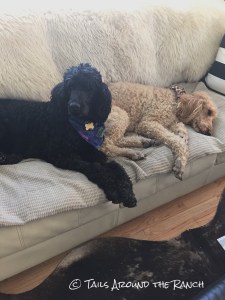 And speaking of blossoming, let me give you an idea of how her disposition and personality are starting to emerge. Elsa is a very sweet dog and now actively seeks attention, even from many strangers and dogs. She desperately wants to engage her big brother in dog play though Sam’s attitude is not yet fully on board with rough-housing because he’s (a) either a total wuss (b) has no idea exactly how to play or (c) a combo of both (a) and (b). She’s now convinced before we go for our morning walks that I’m a suitable chew toy substitute. My 4 year old is experiencing puppyhood for the first time!


