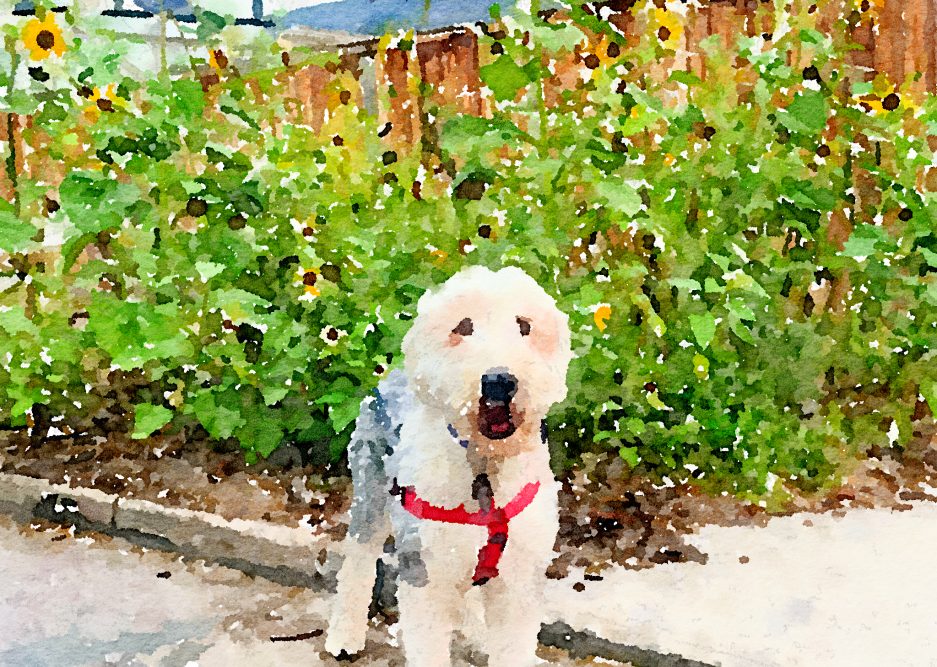
 Greetings sports fans, Elsa here. Welcome to the latest edition of Nature Friday where we’re joining our hosts, Rosy and Sunny from Adventures of the LLB Gang. Be sure to click on their link to see what others have shared. First off, the heat of the past 87 years finally broke, and we’re experiencing some very lovely temperatures and, get this…even had a little spot of wet stuff yesterday evening. Whoa…I almost had forgotten what that felt like. Anyway, let’s get started. It’s been a very busy week for the Mom-ster and she wasn’t able to get too many photos taken but the House Pony will share what we managed to see.
Wilson: Top of the mornin’ to you, little sister. Like you, I’m thrilled with the nice cool temps. When we went for our early morning constitutional, it was a crisp 58ºF (14ºC) this morning and we both were high stepping it along our route. The air was clean and fresh after a little shower last night and everything looked quenched instead of crunchy and brownish. It’s always quite remarkable how even just a small spot of rain can refresh the landscape when supplemental waterings merely keep things alive but never near as verdant as a bit of rain. This year with the heat and lack of early season frost, the fruit crops have done well. Peaches for instance, look quite juicy and sweet. They are most tasty but Mum says dogs cannot eat the stones since they have naturally occurring cyanide and are quite toxic to us dogs. They also could cause a blockage which would require immediate surgery. She’s really paranoid about it since a friend’s sheepdog passed away from eating a peach pit. I say let the bloody squirrels have the pits.

Elsa: Not everyone knows that Colorado peaches are some of the best in the country. The best come from Palisade, near Grand Junction. Peach trees in Denver don’t often produce since our early spring can be sketchy for fruit. Palisade’s warm days and cool nights create the perfect climate for bringing out those delicious flavors with larger-sized fruits than those grown elsewhere.
Peaches can be tricky to grow, the crop in Denver doesn’t always produce fruit every year, especially when there are dry conditions or a late frost but when they do, oh my…talk about luscious snacks and scrumptious desserts.
A note of caution to consumers, if you don’t see the ‘Colorado Proud’ sign, you should realize they are not ‘Palisade peaches’ which are known to be extra juicy and extra sweet, thanks to the long sunny days and cool summer nights, which help all those delicious fruity sugars develop. A brief history of Palisade peaches starts with John Harlow. After the local Ute tribe was forcibly removed from their ancestral home on the Western Slope in 1881, settlers began developing the town of Palisade. Farmers discovered the soil was rich and nutrient-filled and perfect for vegetables and grains. But water was in short supply. John Harlow, who along with his wife, planted some of the area’s earliest peach trees in 1882 and spearheaded a canal project to divert water from the Colorado River to irrigate the region, and though it took years for his project to come to fruition, it worked. Palisade peaches are shipped throughout the lower 48 states.
Wilson: On of the many squirrels I encounter on my walks knocked one down near me so I grabbed it and tried to carry it with us but Mum made me drop it. Walks are for walking and sniffing, she reminded me so I dropped it like a good boy and then we had a great walk.
Elsa: So Mom has this thing about Cooper’s Hawks and the mated pair that live in the Silver Maple across the street in our neighbor’s backyard have been flying around the neighborhood. She hears them every morning and tries to call them with the lamest version of their shrill whistle. They must be dumb birds because they respond to her {eyes rolling}. I swear, it’s stuff like that which makes me embarrassed. I know she means well, but…behavior like that jeopardizes my cred as a fierce Ninja on the streets. She’s so fascinated by them but you’d think she’d carry her big camera with her more often so as to capture them much better.

Wilson: I for one was gobsmacked when it flew over our heads. I can see why she is so mesmerized by their presence and the fact that they ‘talk’ to her every morning is pretty posh in my books.
Elsa: You see what I have to put up with? Good grief.
Wilson: Not to be out done by the peaches, we’ve managed to find a few nice grape vines as well. They’re well on their way to being fully ripe, but again, these guys are on the “no eat” list. Sheesh, here I am wasting away and all Mum finds are fruit and plants that I’m not supposed to eat. What’s a poor starving dog supposed to do?

Elsa: Oh for crying out loud, stop thinking with your stomach! Is this just a boy thing or is this something all sheepdogs are prone to do?
Wilson: Well if history is correct, we were left with the sheep in the highlands and ate what they ate. Some of us are omnivores. And before you start poo-pooing that, I understand you think wool socks are a food group, so don’t get high and mighty on me, Ninja.
Elsa: {clearing her throat} Ahem…moving along with other flowers and plants…what else you got?
Wilson: {chuckling under his breath} I thought so. Well we managed to find a beautiful specimen of butterfly weed. It’s bright orange blooms could be seen for quite a distance. No wonder butterflies hang out on it. With it’s bushy shape, orange flower color, and interesting seedpod, this xeriscape plant makes a wonderful addition to landscapes in our area. While not native to Colorado, it is a good food source for native insects and butterflies and is a great addition for attracting pollinators. After blooming, seedpods will form and split open in fall releasing showy, silky seeds.

Elsa: Nice color, House Pony.
Wilson: Thanks, Mum says it ‘screams’ its presence to butterflies in the garden and she’s hoping the volunteer will naturalize and bloom again next year.
Elsa: Maybe it’ll end up like the lupine {chuckling under her breath}. Probably good to keep a watchful eye on it but I think Mom learned her lesson with the lupines.
Wilson: When we were out and about recently, we came across this little beauty that Mum had to photograph. It was near the giraffe that I wanted to see up close but Mum warned me it’s guarded by a rather inhospitable chap of a dog so she took a quick pic and we left. Commonly known as moon carrot, Sesli gummiferum, and is easy to grow with its silvery-blue and lacy foliage. It’s a biennial that remains a basal rosette the first year and then grows a thick flower stalk in the second year that bears many pale pink flowers which are clustered in large, flat umbels. The blooms are continuous from midsummer through fall and grows in either full sun or part shade, isn’t fussy about the soil and adapts to moderate or low watering regimes. Because it’s a biennial; two years completes its life cycle so any future generations need to be assured with seeds, then Mother Nature is bound to do the rest.

Elsa: Oooh, pretty. And speaking of pretty, I heard you found a rather unusual rose.
Wilson: We did. This one is special for Rosy. I think she’ll appreciate it.

Elsa: I’m sure she will, big guy. That’s very thoughtful of you. Well that about does it for us this weekend. We hope you have a fabulous weekend. To all our friends on the East Coast, please stay safe as Hurricane (now tropical cyclone) Debby moves through your region. We’re thinking of you and hoping you are dry and well. Have a great weekend.
Wilson: Yes, what she said. ⬆️ Cheerio, mates.
Live, love, bark! 🐾


 Welcome to this week’s edition of Nature Friday where we join our friends from the


 Hope you all managed to survive Explosion Day, aka July 4th. Elsa here. Whew, thank goodness we got through it even though it lasted until after midnight. Mom closed up the house and turned up the volume on the TV so we’d have less to hear. Bless her. Seems like a lot of peeps are beginning to question this whole “let’s blow &#@% up” holiday and not just here in the Mile High. Although Mom thought there were a lot of people who give lip service to ending fireworks but still ran to their favorite fireworks pop up stand and bought a bunch. Still we hope all that barking and whining by folks about it is starting to move the needle. Baby steps. Not only are there alternatives that don’t scare the Bejesus outa


 Elsa: Holy flowers, Batman! That ‘beard’ is very bright!


 Elsa: Mom and I have seen those Alliums on our walking route too. It seems to have been a very good year for Alliums and I’m sure the recent showers have been a good thing for them and all the plants in the garden.


